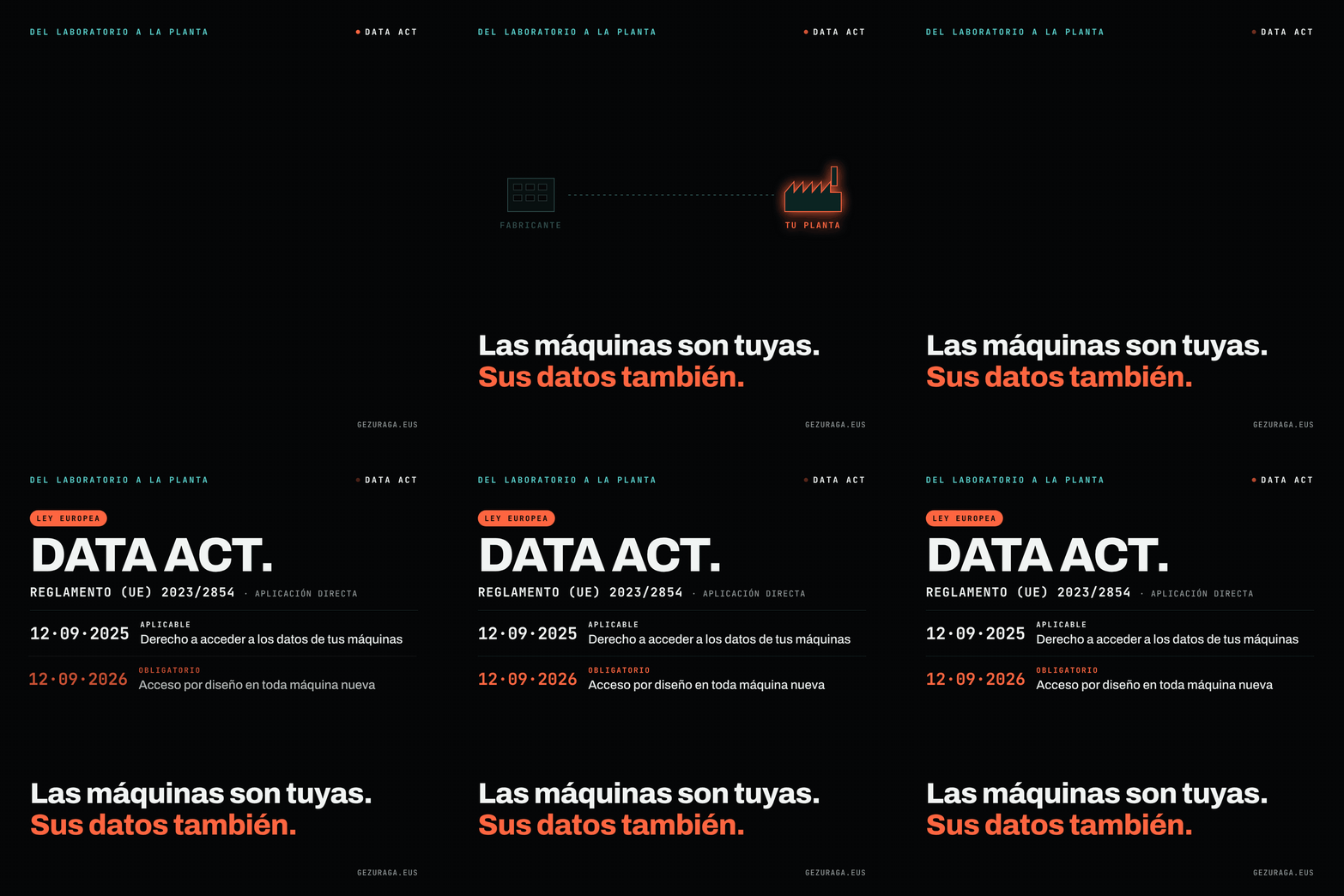
Since 12 September, every connected machine placed on the European market must be designed so that whoever uses it can access its data.
It's the Data Act (Regulation (EU) 2023/2854). And it is quietly changing who calls the shots on industrial data.
For years, the machine manufacturer has been the de facto owner of its data: its cloud, its format, its dashboard. Today the law recognises the right of whoever operates the machine to access that data and use it.
But here's the catch:
“Having the right to your data is not the same as being able to use it.”
A plant may run equipment from ten manufacturers, each with its own data model. Without a common layer, you hold ten keys to ten different houses. And none of them is yours.
Real sovereignty takes three leadership decisions:
- Your own operational data layer, independent of each vendor, where plant data is structured in a common language (OPC UA, Asset Administration Shell).
- Data clauses in every equipment purchase: format, real-time access and the right to share it with third parties.
- Governance of use. Sovereignty is not about where the data sits, but about who decides what it is used for. That is the principle behind the industrial data spaces Europe is already building, such as Manufacturing-X.
The companies that do this first won't just comply. They'll be able to train their own models, share learning without sharing data, and negotiate with their suppliers from a different position.
The Data Act gives you the right. Architecture gives you the capability.
Your machines are yours. Is your data?
With this post I'm starting “From the lab to the plant floor”: advanced technologies brought down to real plant use cases.