As in industry or in management, AI can improve or kill marketing.
I get a lot of sales messages. On LinkedIn, by email, sometimes through both channels on the same day. Almost all of them apply textbook techniques, and the problem is that you can tell it is a textbook.
A few examples, all of them real:
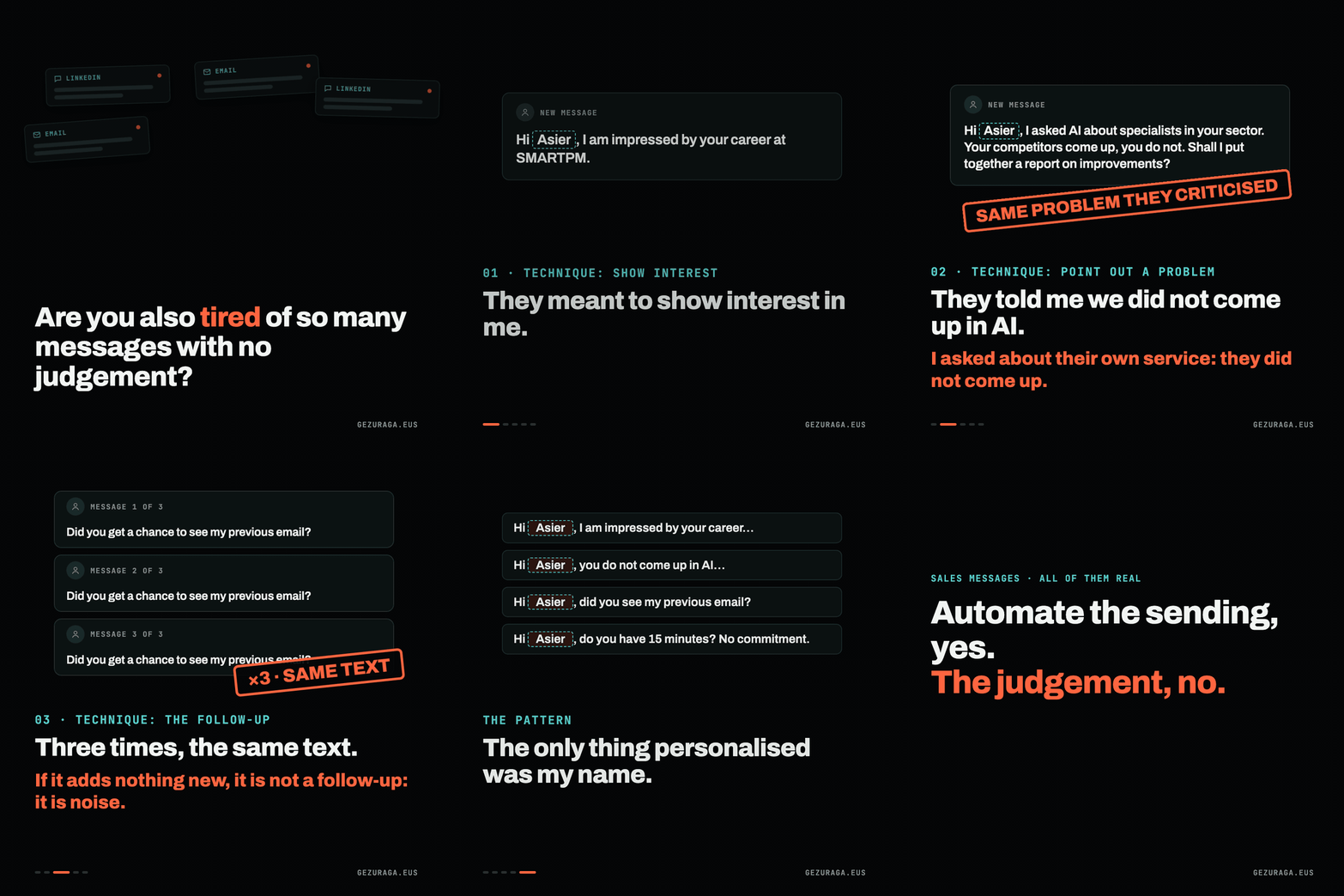
- “I am impressed by your career at SMARTPM.” It reached me when I had been at the company for two months. The technique is to show interest in the person. What they showed is that nobody had looked at my profile.
- “I asked AI about specialists in your sector. Your competitors come up, you do not. Shall I put together a report on improvements?” It was sent by a company that sells exactly that. I asked about their own service: they did not come up either. They had the very problem they were criticising.
- “Did you get a chance to see my previous email?” Three times, with the same text. The technique is the follow-up. But if the third message adds nothing the first one did not already have, it is not a follow-up: it is noise.
- “Do you have 15 minutes this week? No commitment.” They ask before explaining what they offer or why I should care. In a management diary, fifteen minutes are one more meeting. Asking for them without giving a reason is asking me to do the work.
In all four, the only thing personalised was my name.
AI has made writing very cheap. It has not made understanding who you are writing to any cheaper.
Used well, AI should do exactly the opposite: read before writing. Know what the company does, what has changed, what problem it has now. With that, a three-line message is worth more than a hundred templates. The techniques are not burnt out; what burns them is applying them without looking.
Automate the sending, yes. The judgement, no.