Every time we talk about AI in industry I ask myself the same question: where is the data to train it going to come from?
A plant, however large, only sees its own breakdowns, its own defects and its own processes. For a model to really learn it needs many cases, which a company takes a long time storing and structuring. Sometimes not even that is enough.
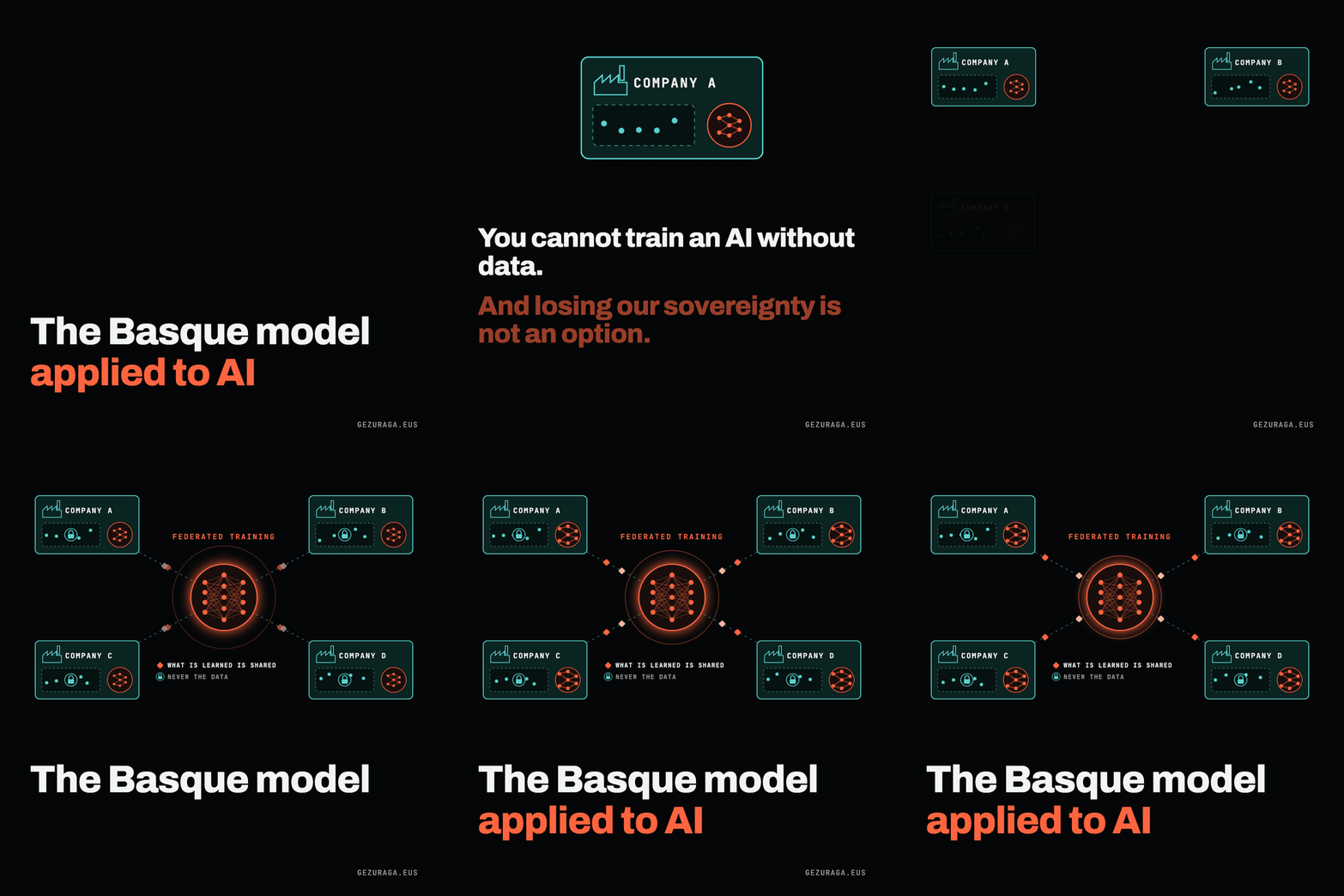
You cannot train an AI without data. And losing our sovereignty is not an option.
The big technology companies solve it with scale, with public data. Industry does not have it. And handing our data to third parties, or sharing it with competitors, is not part of any serious plan.
There is a third way today: federated learning. Each company trains the model at home, with its own data, and only what the model has learned is put in common. What is shared is the learning, never the data. The result is a model that has seen what no company on its own could see.
We already did it here. The Mondragón cooperatives joined forces to create their own bank, their own social welfare provision and their own research centre: things none of them could have built alone. That way of cooperating was the Basque answer to the industrialisation of the twentieth century.
Can the answer for the twenty-first be the Basque model applied to AI?
Companies in the same sector or the same cluster, competing in the market and collaborating on the model. Cooperating in order to compete.
The technology is already here. What is missing is the usual: trust, clear rules and someone to take the first step.
On our own we do not have enough data. Together, we do.